

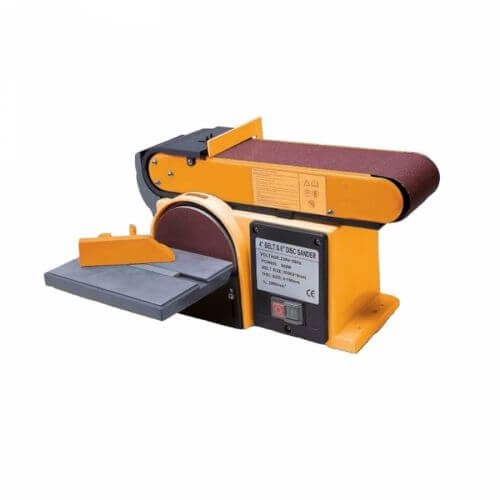
Grinding machines
Now, almost every home has a compact grinding machine for wood and metal, starting with an angle or orbital sander (grinder) and ending with multifunctional high-precision devices. And the production of products, associated with wood and metalworking, cannot do without them at all.
The origin of the modern universal grinding machine originates in the 1860th. When Joseph R. Brown, the head of a small workshop for the production of tools and components for other companies' technology, now known as Brown & Sharpe Mfg, was closely associated with the development of universal grinding machines. The first grinding machine built at Brown & Sharpe Mfg (still used at Brown & Sharpe) was intended not for sale, but for the exact and economical production of its own workshop products. The purpose of this machine was the manufacture of needles and shafts for Wilcox & Gibbs sewing machines. In 1862, the machine visited an exhibition of technical inventions, and hundreds of companies, evaluating performance and accuracy, wanted to buy a grinding machine from Brown & Sharpe. Given the interest in the invention, Brown & Sharpe released more than one such machine. These machines spread all over the world and became an integral part of the global production of wood and metal processing industries. Already by 1874, improving their production, Brown & Sharpe produced machines that perform almost all the operations that a modern machine must perform to this day.
The grinding machine of that time had the following main disadvantages: low speed, low accuracy and the lack of tools for grinding the internal surfaces of hollow parts. Also, the lack of mobility, size, very large weight (over 11 tons) and the fragility of working surfaces are among the disadvantages of the first grinding machines. But it was no longer a forge or sawing, but a real wood-metalworking workshop.
But that's not all. On our vast planet for the last hundred years, a huge amount of equipment and machine tools for various spheres of our life, such as: Woodworking equipment, Metalworking equipment, Equipment for cutting stone, ceramics, etc. were invented and brought to life.
Analyzing the invention suggests the conclusion that the manufacture of parts by such machines could already be considered a conveyor belt, since this machine literally copied all the parts produced, excluding defects and constant calculations of the same thing that the production there was famous for. Perhaps, the universal grinding machine spawned the light and conveyor production. After all, it was from that time that manual work turned into an expensive rarity, and machine tools provided the whole world with relatively inexpensive and high-quality goods.
The universal grinding machine for wood and metal had a very large impact on modern methods of machining materials, increasing the level of craftsmanship, safety and the economy of production.


